Below I will follow our usual practice in Songwei, the appearance of
Fanuc motor features, model series difference, encoder how to see, shaft type (especially the keyway) these practical information, a one-time clear. The content will be more detailed, because it is really what we use every day.
What does a Fanuc motor look like? How to recognize them at a glance?
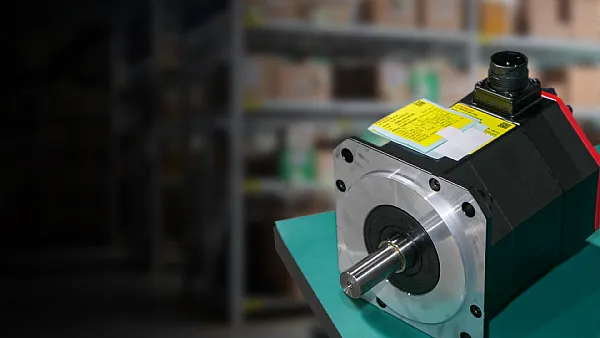
Even if you're not familiar with it, when you see a servo motor with a red back shell and a black body, in all likelihood it's a Fanuc - the color scheme is its trademark.
A few of the most obvious features on the motor:
● Motor shaft
Fanuc The difference between different shaft types is quite large, especially keyway (open keyway) and optical shaft, this is very critical to the selection.
The most common shaft types we usually encounter:
* Keyway shaft: shaft with keyway, used to lock the pulley or coupling
* Smooth shaft: completely round, commonly used in robotics or clamping couplings
* Long shafts / special shafts: more often customized by machine shops
* Tapered shafts: rare, but used in some European equipment
You can tell half the problem just by looking at the motor shaft.
● Encoder back covers
Basically red, round, with encoder label on the back. Accuracy and compatibility varies by age and B-number encoder.
What is the difference between α, β, αi and βi series?
There are three eras that can be seen in the Fanuc motors we take apart every day.
● α and β: the old generation
Many machine tools used this generation from the 1990s to the early 2000s. α has more power, while β is smaller and smaller.
If you see:
* Thick encoder housings
* Encoder numbers like B00x, B20x
* Earlier model ranges
● αi and βi: the most common nowadays
The vast majority of modern machine tools and retrofit projects use the αi / βi series.
Their characteristics:
* Much higher encoder resolution
* Better heat dissipation
* Higher power density
* More energy efficient
For example, motors like A06B-0235, A06B-0203, A06B-0268 are mostly αi series.
How do Fanuc models really look?
Motor model numbers usually look like this: A06B-0235-B202
We Songwei have seen hundreds of models, the pattern is roughly:
* A06B: Fanuc motor category (servo motor)
* 0235: motor size, series of small genealogy
* B202: encoder type, with or without brake, voltage configuration, etc. are hidden here
* may also be followed by # 0100, # 0200 such option code (very important)
If you only report "A06B-0235-B202”, we can know the motor series, encoder big family, with brake or not, but the shaft model will have to look at the option code or the photo to finally confirm.
What is Keyway? Why do so many people get confused?
This is a weekly problem. Especially like: A06B-0235-B202#0100
Followed by #0100, #0200, #7008 these are the option numbers.
Most common:
#0100, stepped axis + Keyway (with keyway)
#0200, Optical shaft (no keyway)
#7xxx, Special Axis / Special Customer Configuration
Whenever you see #0100, 99% of the time it means that the motor is keywayed.
It is very common to see #0200 without a keyway because many devices are now using clamping couplers, which do not require a keyway.
The reason we often encounter "I bought it and it won't fit” is that I bought the wrong type of shaft.
How to check if your Fanuc motor is keyway?
We usually ask our customers to check this way:
1) Look at the photo
We usually ask our customers to confirm this as follows: ### 1) Look at the photo. You can tell by taking a clear picture of the shaft.
2) Look at the suffix of the model number
If there is #0100 → keyway
if there is #0200 → optical axis
3) Check the machine tool manufacturer's documentation.
Mazak, DMG Mori, Doosan, these will all state the motor shaft type.
4) Send us the serial number or nameplate
We can quickly find out the corresponding shaft type from internal data or customer experience.
There are also some small details that engineers often overlook
These are the information we often use when repairing or replacing Fanuc motor:
● Cooling method
Most of them are naturally cooled, some high power models will have rear fans.
● Whether with brake
Brake harness, drive configuration are different, can not be changed.
● Connector Orientation
Some wires come out of the top, some come out of the back or side - this affects installation space.
● Compatibility with drives
α → α drive
β → β drive
αi → αi drive
βi → βi drive
It is basically impossible to directly interchange across series.
Why is it important to read Fanuc models?
In practice, we have encountered too many problems caused by not checking the model number correctly:
* Motor can not be installed (shaft type does not match)
* Encoder not recognized (B-code incompatibility)
* Torque is not enough (series or size bought small)
* Drive alarm
* Even the customer re-machining pulley...
In fact, as long as you read the model number correctly, the selection is very easy.
If you're not sure of the model, shaft type, encoder, Songwei can help you quickly confirm
We at
Songwei deal with testing, repairing, and replacing parts for Fanuc, Mitsubishi, Siemens, OKUMA, and HEIDENHAIN motors and drives every day. When you are not sure of the model number, when you are in a hurry for a project, or when a motor suddenly breaks down, you will save a lot of time by coming to us.



